
When an odor complaint occurs, the useful questions are not limited to “Was there an odor?” Operators need to know when it occurred, whether the signal resembles a trained source, where the wind was blowing, and what equipment was operating.
What an E-Nose does
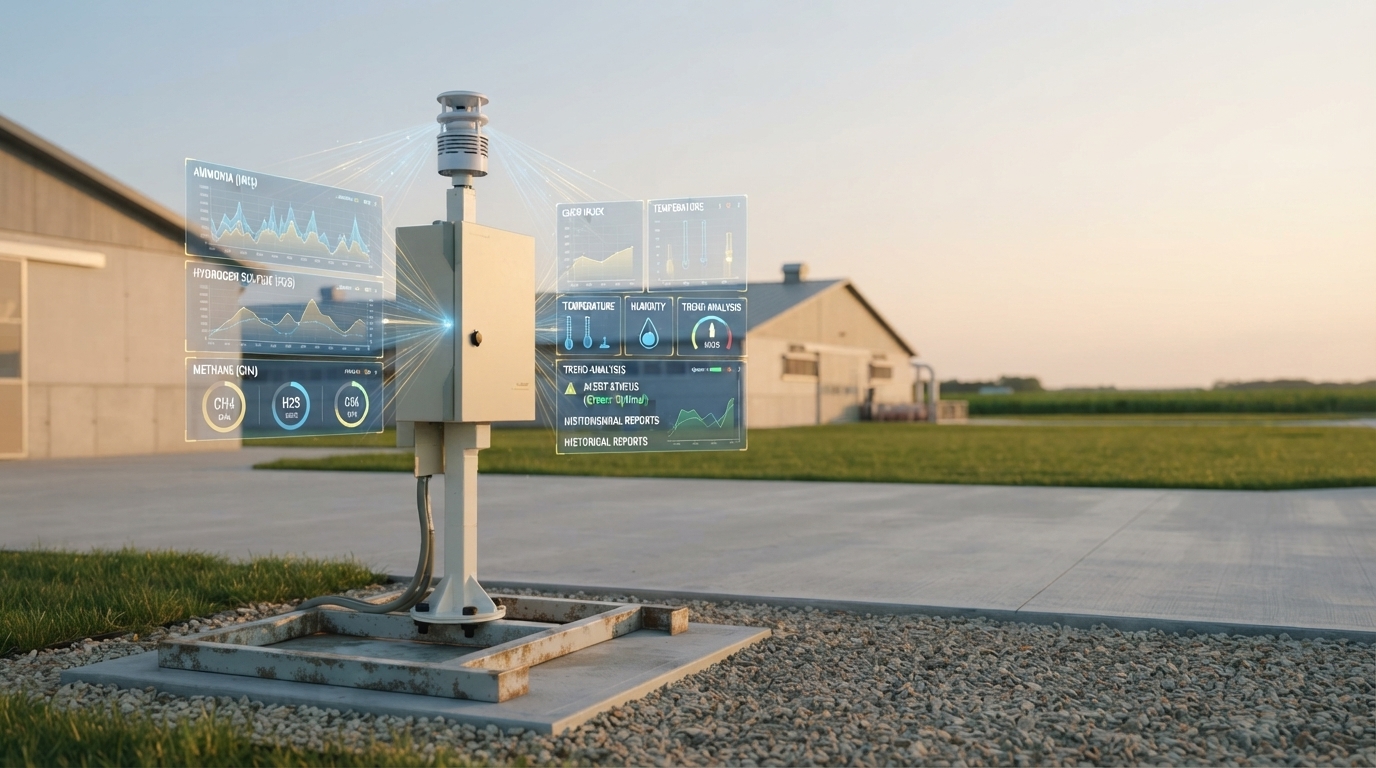
An electronic nose uses an array of cross-sensitive sensors and pattern-recognition software. Its “odor fingerprint” is a repeatable signal pattern—not forensic proof of a uniquely identifiable source. Performance depends on a representative training library and suitable field conditions.
Four evidence layers
| Layer | Purpose |
|---|---|
| Sensor trend | Detect time and magnitude of a change |
| Trained pattern | Compare the event with known samples |
| Wind data | Test whether a transport path is plausible |
| Operating log | Link the event to pumps, fans, washing, or transfer activity |
Implementation workflow
- Map sources, boundaries, receptors, and complaint points.
- Collect baseline and known-source samples under varied conditions.
- Install sensors with co-timed meteorological and operating data.
- Define alerts and an operator response procedure.
- Inspect, calibrate, and retrain as sensors and seasons change.
Important: E-Nose supports trend monitoring and trained-pattern classification. It does not replace dynamic olfactometry, chemical analysis, field inspection, or every regulatory method.
Buyer checklist
- What samples train the model?
- Are wind and operating records synchronized?
- Does reporting show confidence and unknown events?
- Who calibrates sensors and maintains the data?
- What action follows an alert?
Takeaway
The value comes from the complete management loop, not a standalone device. RE-Solve designs baseline collection, placement, data integration, dashboards, and response procedures around each farm.
Request a monitoring-plan assessment for your site.
References