

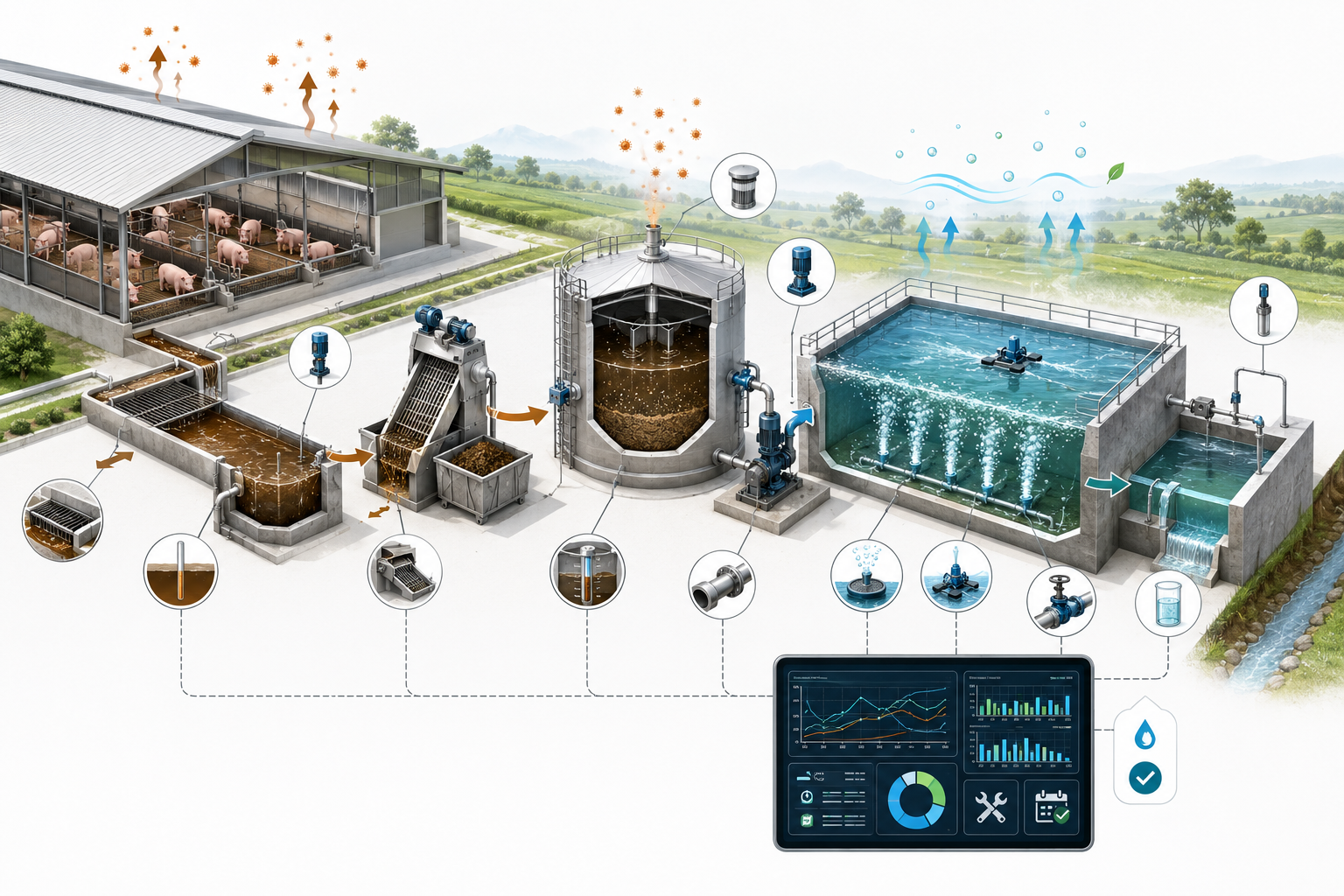
Wastewater treatment can be a major odor-source group, but source shares are not identical across farms. Installing equipment from a single assumption can simply transfer odor from water to air.
Map the system first
- Receiving and equalization points
- Anaerobic covers, vents, and leaks
- Open ponds with remaining organic load
- Pumping, transfer, washing, and solids handling
Match technology to function
| Method | Function | Design inputs |
|---|---|---|
| Air sparging | Improve oxygen transfer and water conditions | Volume, organic load, depth, energy |
| Pond cover | Contain and collect off-gas | Pressure, safety, rain, maintenance |
| Activated carbon | Adsorb compounds from collected air | Flow, humidity, contact time, media life |
| Stack | Discharge managed air appropriately | Height, exit velocity, wind, receptors |
Case-study context
One demonstration project reported a reduction at the farm from 10.02 to 4.17 D/T (58.38%) during its assessment. This is a site-specific result, not a universal guarantee; wastewater strength, weather, existing assets, and operation all affect performance.
Takeaway
RE-Solve starts with baseline assessment, then defines the design, budget, and measurable KPIs.