

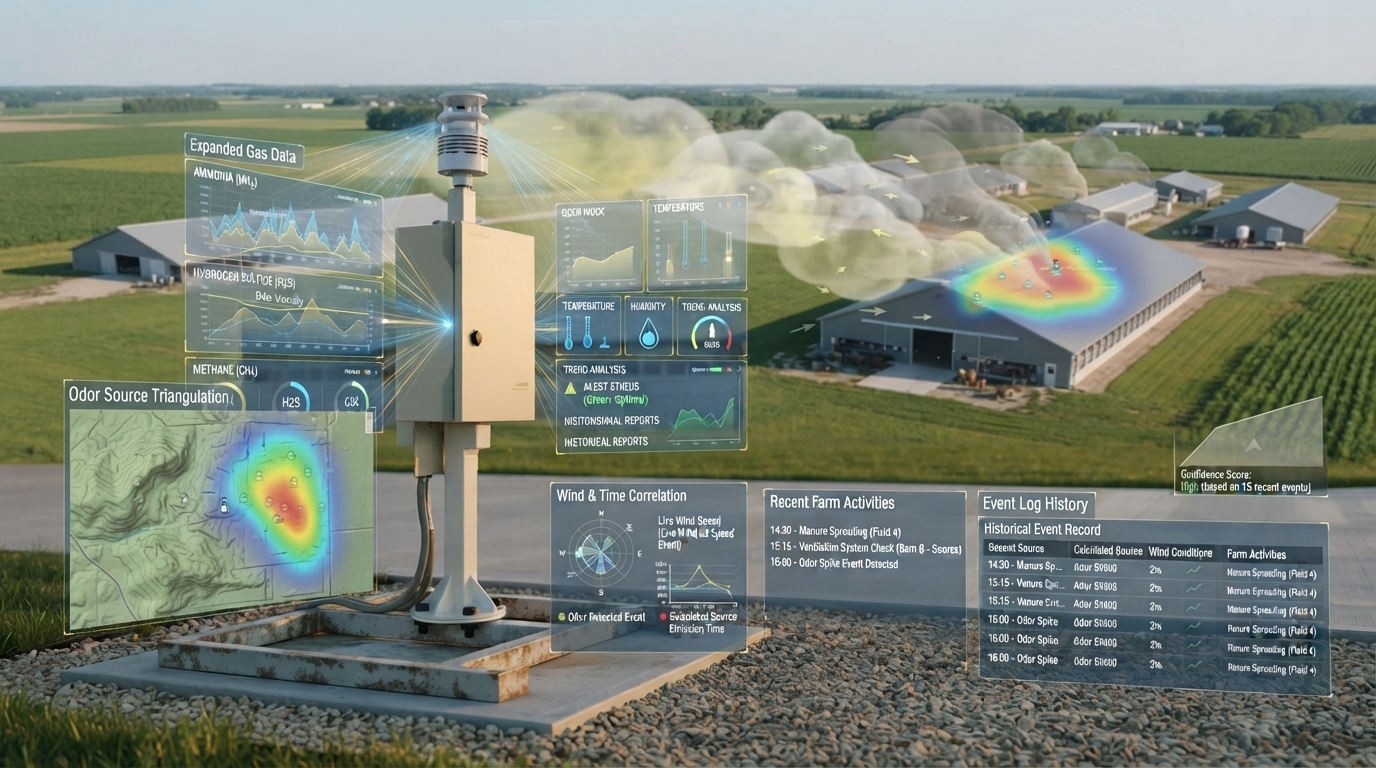
A high reading at a receptor confirms an event, not its source. Odor travels with wind, changes with atmospheric turbulence, and may come from several nearby activities.
Four evidence layers
| Evidence | Question |
|---|---|
| Odor trend | When did it start and end? |
| Wind | Was a suspected source upwind? |
| Operating log | What was the farm doing? |
| Field observation | Did character and location agree? |
Response workflow
- Validate timestamps and data quality.
- Review minute-level wind rather than a daily average.
- Compare the sensor pattern with trained sources and confidence.
- Check pumps, fans, washing, transfer, and alarms.
- Inspect using a defined SOP.
- Classify the event as farm-related, another source, unknown, or insufficient evidence.
Common mistakes
- Ignoring calm wind and wind speed
- Treating a fingerprint match as absolute proof
- Unsynchronized sensor, weather, and PLC clocks
- Reporting only events that fit an initial assumption
Takeaway
Time-aligned evidence turns complaint handling into a repeatable investigation. RE-Solve can design station placement, time synchronization, dashboards, and response procedures for the local farm-community layout.